
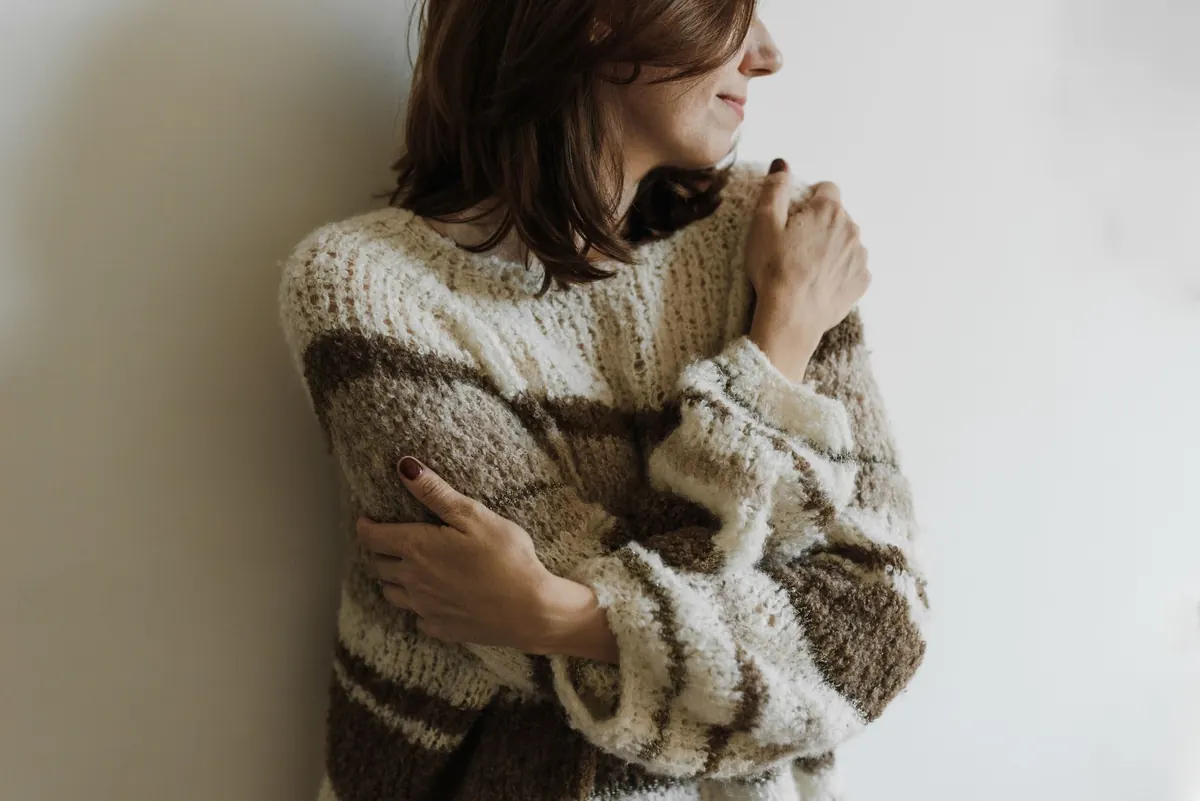
There is a moment every winter when you pull a heavy cable-knit sweater over your head and feel instantly better. Then you catch your reflection and wonder whether you gained ten pounds between the bedroom and the hallway. You didn't. Cable knitting is dense, worked from thick yarn, and it adds volume in every direction at once, which is exactly why it feels so good and looks so tricky.
The fix isn't a thinner sweater. Bulk is a layering problem, and it's solvable. Get the underlayers thin, the outer layers smooth, and the proportions deliberate, and the same heavy knit that swallowed you yesterday reads as texture and structure today.
Start With a Base Layer That Disappears
The layer closest to your skin sets the ceiling on how slim everything above it can be. Start with a thick cotton tee or a fleece-lined top and you have already added half an inch of padding, plus a rough surface for the sweater's inner seams to catch on. The sweater rides up, the shoulders shift, and you spend the day tugging.
What works under a chunky cable knit is something fine, smooth and close to the body. A few options that behave well:
- Fine-gauge merino or silk-blend long-sleeve: thin, warm, and slick enough that the sweater slides over it instead of bunching.
- A thin cashmere or cotton crew neck: good when you want a collar to peek out at the neckline.
- A fine-knit turtleneck: the single best trick for a crew-neck cable knit. It fills the gap at the neck with a clean vertical line and removes any need for a scarf.
- A lightweight silk or modal camisole: enough for a heated office or a mild autumn day.
Skip anything with a thick ribbed hem, a bulky seam down the shoulder, or a brushed fleece interior. Those details print themselves straight through the knit.
Read the Sweater's Fit Before You Buy
Two chunky cable knits of the same yarn weight can look completely different depending on the cut. The details that matter most:
Shoulder seam. On a thick knit, the seam should sit at your natural shoulder or slightly inside it. A drop shoulder plus chunky yarn is the most volume-adding combination in knitwear, because the extra fabric has nowhere to go but outward.
Armhole and sleeve width. Hold your arms straight down and look at the side seam. If it bows outward at the elbow, the sleeve is too wide. A slightly narrower sleeve that tapers toward the wrist keeps the top half of your body looking long.
Length. The worst place a heavy sweater can end is the widest part of your hips. Aim for the hip bone, just below it, or a deliberate crop that meets the waistband of high-rise trousers.
Ease. You want roughly an inch of room, not a handful. If you can grab a fistful of fabric at the side seam, the sweater is oversized, and oversized plus chunky rarely looks intentional.
If You Already Own the Bulky One
You can still wear it. Treat it as outerwear rather than a mid-layer: put a fine turtleneck underneath, leave the sweater open if it's a cardigan, and pair it with the leanest bottoms you own. A heavy knit with slim, tapered trousers reads as a deliberate contrast. The same sweater with wide pleated pants reads as a tent.
Tucking, Belting and Managing Length
The half-tuck is the most useful move in this whole guide. Gather a small amount of fabric at the front hem and tuck it into your waistband, leaving the back loose. You get a defined waist point and a diagonal line across the hip, which does more for your silhouette than any amount of dieting.
A full tuck works only on thin knits. Cable knit is too dense to sit flat under a waistband, and you'll get a shelf of fabric above your belt. If you want a belt in the picture, wear it over a tucked fine-gauge layer and leave the sweater open or cropped instead.
One defined waist point per outfit. Not two, not none.
If your sweater is long and you don't want to tuck it, give it a lean partner: a column midi skirt, straight-leg jeans, tapered wool trousers. The eye follows the narrowest line in the outfit, so give it one to follow.
Jackets and Coats That Layer Over Cable Knit
The single rule for outerwear: the inside of the coat must be smoother than the outside of the sweater. A slippery lining lets a chunky knit slide in and out without dragging your base layer up with it.
Look for cupro, viscose, silk or a smooth polyester lining. Avoid shearling-lined sleeves, brushed fleece linings and quilted linings with a raised texture; they grab the knit, and you end up wrestling your way into your own coat.
Shapes that work over a heavy cable knit:
- A raglan-sleeve wool coat with generous armholes. Raglan seams follow the slope of the shoulder instead of fighting it.
- A long puffer with a slick lining and a slightly relaxed fit through the chest.
- A leather or moto jacket sized up one. Leather is smooth but unforgiving, so check that you can raise both arms without the jacket pulling across the back.
- A double-faced wool coat worn open. The unlined edges keep it light, and wearing it open creates two long vertical lines.
Blazers are the hard one. A structured blazer over a chunky cable knit usually ends in a fight for shoulder space. If you want that look, choose a fine-gauge cable knit, or wear the blazer unbuttoned with the sweater tucked at the front.
Balance Everything Below the Waist
Volume on top needs a clean, slightly narrow bottom half. High-rise straight-leg jeans, slim bootcut denim, tapered wool trousers, a fine-gauge knit skirt, a column midi. All of these give the sweater something to sit against.
Colour helps too. A single column of tone from sweater to trousers makes you look taller and narrower than a contrast break at the hip. If you want contrast, put the darker shade on the bottom and keep the sweater mid-tone rather than bright.
And watch the shoes. A chunky sweater, wide jeans and a slouchy wide-shaft boot is three soft shapes stacked on top of each other. Swap the boot for something with an elongated toe or a defined heel and the whole outfit sharpens.
Small Moves That Trim the Line
- Push the sleeves up to just below the elbow, then let them settle at the wrist bone. Cuffing a chunky sleeve adds a crisp edge and shows your forearm.
- Steam the sweater before you wear it. A knit that has been squashed in a drawer looks lumpy, and lumpy reads as bulky.
- Wear a fine-knit scarf, or none at all. A chunky scarf in the same yarn as the sweater doubles the volume exactly where you don't want it.
- Add one long vertical element: an open shirt collar under the neckline, a slim pendant, a coat worn open.
- Choose a crossbody bag with a slim strap and wear it short, so it crosses the chest on a diagonal rather than hanging at your hip.
The Two-Minute Bulk Check
Before you leave the house, do this in front of a full-length mirror. It takes less time than changing your shoes.
- Stand sideways with your arms down. Is the sweater's outline close to your own, or is it standing off the body by several inches?
- Check where the hem lands. Hip bone, just below it, or a deliberate crop. Not the widest point of the hip.
- Reach both arms forward. If the sweater pulls tight across the back, your base layer underneath is too thick.
- Put the coat on. One smooth layer inside, no wrestling.
- Find your waist point. If you can't see one, half-tuck the front.
None of this requires a new wardrobe. It requires one thin base layer, one coat with a decent lining, and the discipline to half-tuck. A cable-knit sweater is supposed to look substantial; that's the pleasure of it. The goal isn't to hide the weight of the knit, it's to make sure the knit is the only heavy thing in the outfit.
On the coldest days, though, feel free to abandon all of it, wrap a scarf around your neck and enjoy being warm. Style is supposed to make getting dressed easier, not stricter.
Photo: Arina Krasnikova / Pexels