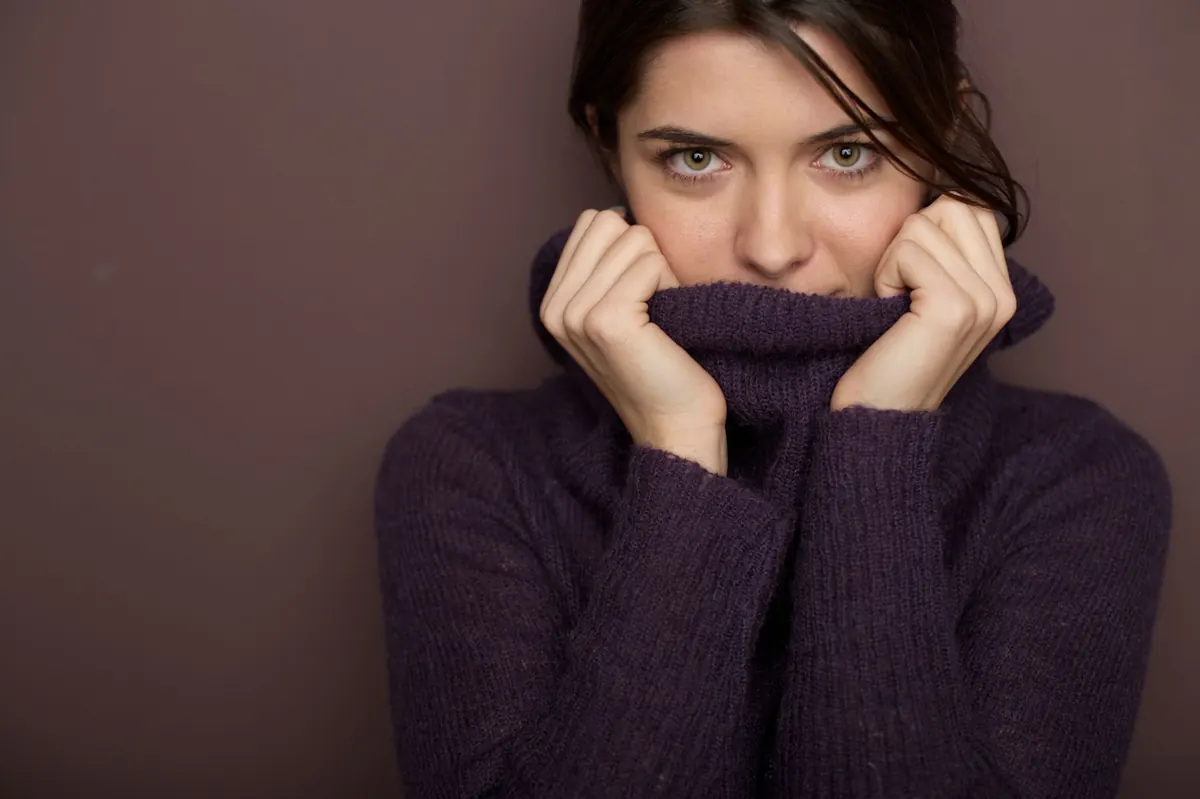
A sweater's neckline frames your face the way a haircut does. The right opening lifts your features and makes the whole outfit look considered. The wrong one pulls everything down toward your shoulders. Most of us shop knits by color and fiber, barely glancing at the shape of the collar. Flip that order: neckline first, then color, then yarn.
Find Your Face Shape in Thirty Seconds
Pull your hair back, stand in front of a mirror, and trace the outline of your face with a finger. Or take a straight-on photo in daylight and note where the widest part sits.
- Round: Width and length are close to equal, with a soft jaw and full cheeks.
- Square: Forehead, cheekbones and jaw sit at roughly the same width, with defined corners.
- Oval: Slightly longer than wide, with a gently tapered jaw and balanced proportions.
- Heart: Wider at the forehead and cheekbones, narrowing to a smaller or pointed chin.
Most people are a blend, so pick the trait that stands out and work from there. Necklines aren't rules. They're tools for adding width, length, or softness exactly where you want it.
Round Faces: Reach for Angles
A round face benefits from anything that creates a vertical line or interrupts the curve. The V-neck is the easy answer: one that ends around the top of your sternum draws the eye downward and lengthens the whole picture. A deep scoop does similar work with a softer edge.
Crew necks are where round faces get tripped up. A high, snug crew sits right at the widest point of the face and makes it read rounder. That doesn't mean banishing them. Look for a crew with a wider, slightly scooped opening that clears the collarbone, and keep the ribbing flat rather than chunky.
Turtlenecks are the other contested one. A stiff, tight tube adds bulk directly under the chin. A fine-gauge ribbed turtleneck, or one that folds over with a little slouch, skims instead of stacks. Wear it with an open jacket or a long pendant and the vertical line comes back.
Boat necks are the hardest sell here. That horizontal line widens the shoulders, which is wonderful for some faces and wrong for round ones — especially a straight bateau running flat across the collarbone.
Best bets: V-neck, deep scoop, draped cowl, an unbuttoned cardigan.
Square Faces: Soften and Stretch
A strong jaw is a good thing to have. Your job is to keep the neckline from echoing it too literally.
Curved openings do the most: a rounded scoop, a soft V, or a cowl that drapes rather than sits flat. A literal square neckline repeats the jaw's geometry, which can look severe if that isn't the effect you're after.
Crew necks work when the opening isn't too narrow. A crew that cuts close to the neck mirrors the line of a square jaw; one that sits a finger's width away reads as softer.
Turtlenecks suit square faces as long as the fabric has some give. A slouchy fold-over or a slim ribbed style adds softness around the jaw. A stiff, thick stand-up collar squares everything off. Boat necks balance a defined jaw by widening the shoulder line — unless your shoulders are already broad and you'd rather not add width there.
Oval Faces: You Have Range
Oval is the shape stylists call balanced: slightly longer than wide, with a jaw that tapers gently. Nearly every neckline works, which means the choice is really about what you want to emphasize.
Two small cautions. Very deep Vs can stretch an already-long face further. Very high, tight turtlenecks can do the same from the other direction. If you want either, offset it with width — a boat neck's horizontal line, or a crew with a generous opening.
Otherwise, use the neckline to steer attention. A cowl draws the eye to texture near the face. A boat neck shows off collarbones. A crew keeps things clean and lets a bold color or cable pattern do the talking.
Heart-Shaped Faces: Fill the Jawline
Heart shapes are wider across the forehead and cheekbones and narrower at the chin. The goal is to add a little width and weight lower down so the face doesn't taper away.
Boat necks are your best friend. That horizontal line pushes the eye outward and makes the jawline look fuller and more even. Crew necks and mock necks do something similar by filling the space under the chin, and scoops widen without pointing downward.
The one to think twice about is a deep V. It creates a long vertical line that ends near the chin, emphasizing the narrowest part of the face. A shallow V, finishing well above the collarbone, is fine. A plunging one usually isn't.
Turtlenecks help here — a fold-over or cowl style adds visible volume right where you want it. So do collars, scarves, and a chunky chain or bead necklace. Anything that puts something solid below the chin works in your favor.
The Neckline Cheat Sheet
- Crew: Round opening near the base of the neck. Mid-depth versions are the most versatile; high, narrow ones shorten the neck and emphasize roundness.
- V-neck: The strongest vertical line in knitwear. Depth matters more than width — a V ending near the top of the sternum flatters almost everyone.
- Turtleneck: Warmth plus a frame around the face. Slim ribbed versions skim; chunky ones add bulk. Fold-over and cowl styles are more forgiving than a tight tube.
- Boat: A wide horizontal line from shoulder to shoulder. Widens the upper body and shows the collarbone — excellent for narrow shoulders and narrow chins, less so for broad shoulders and very round faces.
- Scoop: The quiet middle ground. Rounded, widening, rarely wrong.
- Cowl: Soft drape and texture near the face. Adds movement and a little vertical interest without a hard line.
Before You Buy: Fit, Fabric, and a Ten-Minute Try-On
The neckline gets you most of the way. These details finish the job.
- Depth matters more than the label. "V-neck" covers a huge range. Hold the sweater to your chest and check where the point lands. Below the sternum reads dramatic; at the collarbone, it's a workhorse.
- Check the ribbing. Firm, tidy ribbing around the opening keeps its shape through washes. Flimsy ribbing goes slack and sags by mid-winter, undoing the line you chose.
- Mind the shoulder seam. A seam sitting on your shoulder bone gives the neckline a clear starting point. Dropped shoulders change the silhouette entirely — not bad, just different.
- Layer it before you commit. If you'll wear it under a blazer or coat, try it on with one. Some necklines look great alone and vanish under a collar.
- Take one photo. Chest-up, daylight, hair the way you actually wear it. Compare two sweaters side by side. It's faster than a mirror and far more honest.
Start with one neckline you know works and build around it. Once you can see why a sweater flatters you, shopping gets quicker and considerably less expensive.
A neckline is a frame, not a rule. Use it to add length, width, or softness where you want it — then wear the sweater you love.
Photo: BOOM 💥 Photography / Pexels