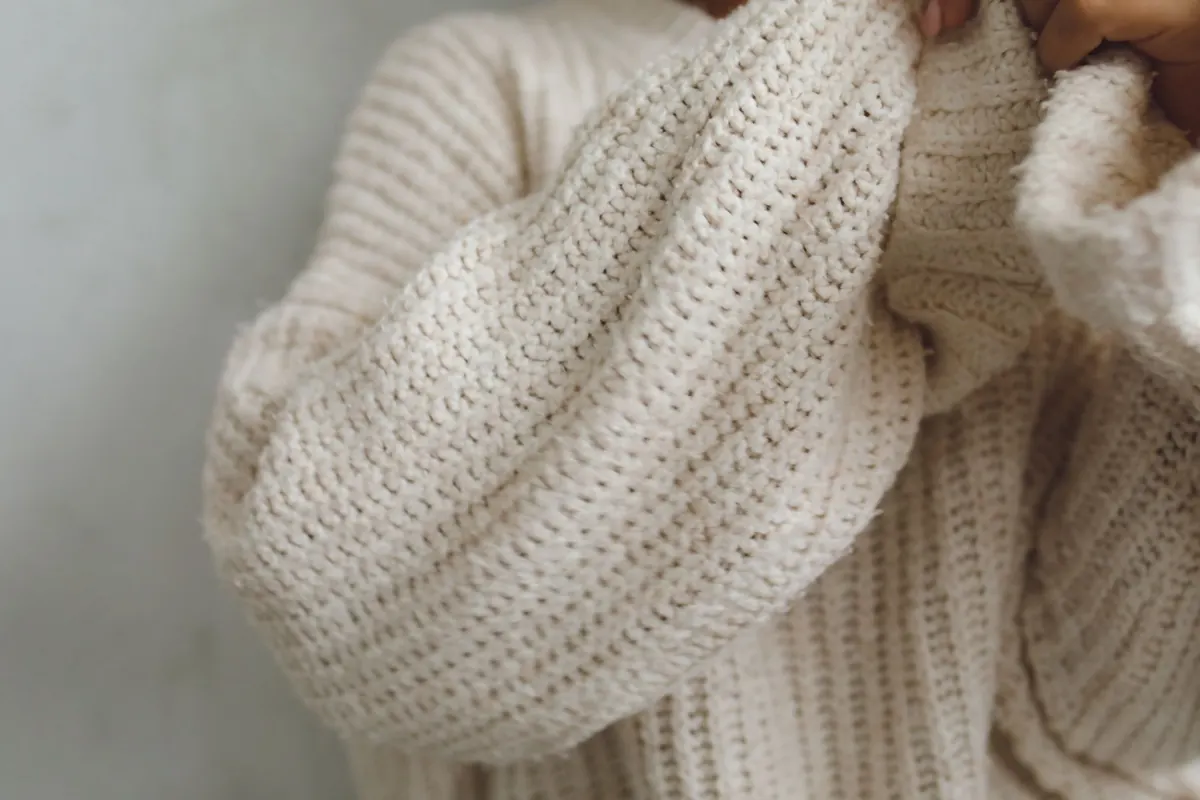
A knit can be beautiful, well made, and exactly your color, and still make you look like you dressed in the dark. The sweater is rarely the problem. What makes an outfit read frumpy is almost always placement: where the hem lands, how the fabric is tucked, how many soft layers are stacked together, and whether the colors are helping each other. Five habits cause most of it, and all five are fixable in front of a mirror.
The Hem That Lands at the Widest Point
Pull on a sweater and look at where the bottom edge stops. If it hits the widest part of your hips or the fullest part of your stomach, that line becomes a visual shelf. The eye reads horizontal, and the body reads wider than it is.
You have three good options. A shorter hem — cropped styles that finish an inch or two below the waistband of high-rise trousers — keeps the line clean and lets the trousers do the shaping. A longer hem works too: if a sweater skims past the hip and ends on the upper thigh, it reads as a deliberate tunic rather than an awkward stop. The third option is to change the line entirely with a tuck.
One trap worth naming: the tight ribbed band. On a boxy sweater it grips the hips and pushes the rest of the fabric outward, which creates a mushroom shape. If your sweater does this, try a size up, or look for a straight or split hem instead.
Quick test
Stand sideways in a mirror. If the hem forms a hard horizontal line across the widest part of your body, move it — up, down, or tucked.
Tucking: All, Half, or Not at All
The front tuck is the fastest way to make a plain sweater look styled, but it has to be done with intent. A full tuck into a thick waistband on a chunky knit creates a bulge at the belt and pulls the shoulders out of shape. A half tuck done carelessly — grab and stuff — looks like you got warm and gave up.
Do it like this:
- Put the sweater on over your trousers or skirt and let it hang.
- Pinch the front center of the hem and tuck in about three inches, no more.
- Let the sides fall, then pull a little fabric back out so the tuck looks loose, not packed.
- Smooth the back flat with your hands so nothing bunches at the waist.
Fine-gauge knits tuck more easily than chunky ones. If the sweater is thick, tuck it into a piece with a flat waistband rather than a pleated one. If it's genuinely bulky, skip the tuck and belt a longer cardigan instead — the belt creates the waistline the tuck was supposed to give you.
Piling Volume on Volume
Layering is where knitwear goes wrong quietly. Each piece is fine on its own. Together they add up to a padded silhouette.
The usual suspects:
- A crisp collared shirt under a chunky cable knit — two collars' worth of fabric at the neck, plus sleeves bunching inside sleeves.
- A blazer over an oversized sweater — structured shoulders plus soft bulk equals a box.
- A heavy sweater under a fitted coat — the coat strains, the sweater crushes, and both look worse.
The rule that fixes it: one structured layer, one soft layer, and never two of each. A shirt under a sweater works beautifully when the shirt is fine cotton or silk with a small collar. A blazer works over a thin merino crewneck, not over a cable knit. A coat works over a sweater if it was cut to fit over one — otherwise choose a cardigan and let the coat be the outer shape.
Check your sleeves too. If you can feel a cuff digging a ridge into your forearm, the layers are too tight and the whole outfit will read cramped.
One Big Thing Per Outfit
An oversized sweater is a statement. So are wide-leg trousers, chunky boots, and a big scarf. Wearing all of them at once is what turns a good outfit shapeless, because there's no narrow point left for the eye to rest on.
Balance the volume instead. Wide trousers with a fitted or lightly cropped knit. An oversized sweater with slim jeans, a straight skirt, or leggings. Chunky boots with a slimmer leg, or slim shoes with a wide one. You don't have to be strict — you just need one part of the outfit to be narrow.
Showing a little skin helps the proportions as well: a wrist, an ankle, the line of the neck. Three inches of ankle above a boot changes how the whole column of a long sweater reads.
Colors That Cancel Each Other Out
Two mistakes show up here constantly. The first is wearing a sweater that nearly matches your trousers but doesn't. Two slightly different greys, two beiges a shade apart. The eye wants either harmony or contrast, and near misses look like a laundry accident. Either match exactly, or pick a clear contrast: cream against navy, rust against charcoal, black against oatmeal.
The second is texture stacking. A fuzzy mohair sweater over brushed flannel trousers over suede boots is three soft surfaces competing. Pick one textured piece and keep the rest smooth — a chunky wool knit with smooth denim and leather boots, or a fine cashmere crewneck with a textured skirt.
If you're unsure, build a column of one color family from shoulder to ankle and let the sweater's texture be the only variation. It reads polished every time.
The Details You Stop Seeing
Some frumpiness isn't styling at all. It's wear and fit. Check three things before you blame the outfit.
Shoulder seams. On a classic sweater, the seam should sit at the edge of your shoulder bone. If it falls halfway down your upper arm, it's a drop shoulder — fine, but only if the body is cut deliberately narrow. A drop shoulder plus a loose body equals a slouch.
Sleeve length. Sleeves that stop at your knuckles make hands look small and arms look short. Push them to the wrist bone or roll them once. If a cuff has stretched out, a light steam can bring it back.
Pilling and fuzz. A sweater covered in pills looks tired no matter how good the styling is. A fabric shaver takes five minutes. For wool, wash inside out in cold water on a gentle cycle in a mesh bag, or by hand, and dry flat rather than hanging.
The Five-Minute Reset
Before you leave the house in a knit you're unsure about, run this check:
- Look at the hem. Is it sitting on your widest point? Move it up, down, or tuck it.
- Do a proper half tuck and smooth the back.
- Count your layers. If two are soft and two are structured, remove one.
- Find the narrow point in the outfit. If there isn't one, make one.
- Check the color: match it exactly or contrast it clearly.
- Smooth the shoulders, fix the cuffs, de-pill anything visible.
None of this requires new clothes. Most of it requires ninety seconds in a full-length mirror, which fixes more knitwear problems than any shopping trip.
Photo: Polina Tankilevitch / Pexels